

Most exchanges require you to hand over a government-issued ID, proof of address, sometimes a selfie, or other details before you can buy bitcoin. That process ties your identity to your bitcoin holdings in a way that’s hard to undo. If you value your financial privacy, that trade-off is serious.
This guide covers what buying without KYC actually means and the three methods that still work in practice.
TL;DR
- P2P platforms like Bisq, Hodl Hodl, and Peach connect buyers and sellers directly, often without formal KYC.
- In-person cash trades offer the highest level of privacy but require careful coordination and safety precautions.
- Bitcoin ATMs can be used for small purchases, but fees are high and verification rules are tightening.
- No-KYC buying removes the identity record at purchase. Self-custody handles the rest.
What Does No KYC Actually Mean?
KYC stands for ‘Know Your Customer.’ It’s a legal requirement that financial institutions and many exchanges use to verify who their users are. When you go through KYC, you submit documents that tie your name and address directly to your account and every transaction you make on that platform.
Buying bitcoin without KYC removes the formal identity link at the point of purchase. Your wallet address is on-chain, but there’s no database connecting it to your name or home address. Bitcoin transactions are still publicly visible on the blockchain and can often be traced through analysis.
‘No KYC’ is about removing the identity record, but not completely disappearing from the blockchain.
If you’re buying bitcoin in Australia and are interested in what’s still available and how to secure what you buy, you’ll find all the steps covered in this guide from The Bitcoin Way.
Where to Buy Bitcoin Pseudo-Anonymously
The three methods below differ in convenience, speed, cost, and the level of privacy each gives you.
Peer-to-Peer (P2P) Platforms
P2P platforms connect buyers and sellers directly, without a central exchange holding funds or verifying identities. You browse open offers, pick a seller whose price and payment method work for you, and start a trade. The platform holds the bitcoin in escrow until both sides confirm payment.
A few platforms do this well. Bisq is open-source and runs as a desktop application over the Tor network. It also requires no registration. Hodl Hodl is web-based and uses multisignature escrow on the Bitcoin network, plus it supports a wide range of fiat payment methods. Peach Bitcoin is a mobile app built specifically for bitcoin with a focus on simplicity and privacy.
Pros
- No identity verification is required on the main platforms listed above in standard use (though requirements can change based on jurisdiction or specific cases).
- The platform never holds your funds; your bitcoin is released from escrow directly to your wallet.
- Flexible payment options: bank transfers, cash deposits, gift cards, and more.
- Escrow protects you if a counterparty doesn’t follow through.
Cons
- Trades take longer than on a centralized exchange, often between 30 minutes and several hours.
- Liquidity is lower, so finding a seller at your preferred price can take patience.
- Scams exist, so stick to platforms with a solid reputation system and always use escrow.
In-Person Cash Trades
Some P2P platforms let sellers list offers for in-person cash trades. You meet in a public location, hand over cash, and receive bitcoin to your wallet on the spot. Bisq and Hodl Hodl both support cash payment methods. There are also community forums and local Bitcoin groups where people arrange trades directly.
This method can reduce the digital payment trail between you and the seller.
Pros
- No bank transfer or payment record connecting your identity to the purchase.
- Fast settlement once you meet the seller and confirm receipt.
- Highest degree of pseudonymity among the three methods, assuming you take the right precautions afterward.
Cons
- Finding a trustworthy seller takes time and careful vetting.
- Meeting in person carries safety considerations that online trades don’t. Always meet somewhere busy and public.
- Trade volumes tend to be smaller, so large purchases get more logistically complicated.
Bitcoin ATMs
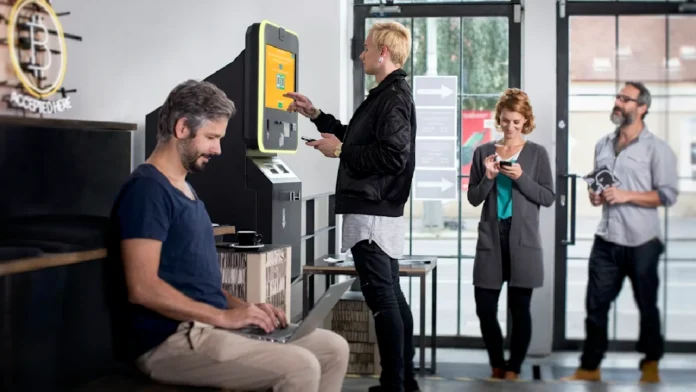
Bitcoin ATMs are physical machines that let you insert cash and receive bitcoin directly to a wallet address. You scan your wallet’s QR code, feed in cash, and the machine sends bitcoin to your address. The whole process takes a few minutes.
Depending on your location, some operators still allow smaller purchases below a certain threshold without ID verification, but that’s increasingly rare. Above the threshold, they may require a phone number or email at a minimum, and some ask for a government ID scan. Requirements vary by operator and jurisdiction, so check before you use this method.
Pros
- Widely available in parts of North America and Europe.
- Quick for small cash purchases with no account required.
- No platform to trust with your funds.
Cons
- Most operators charge high fees, which makes them expensive for anything other than small, occasional purchases.
- Many machines have cameras, so you may not give your name, but your face is on record.
- Verification thresholds are getting lower as regulations tighten.
What to Do After You Buy: Securing Your Bitcoin
Buying bitcoin without KYC is only the first step. If you leave your bitcoin on a platform or exchange after purchase, you haven’t achieved financial sovereignty. You’ve just moved the trust problem somewhere else.
The moment you buy, move your bitcoin to a hardware wallet where only you control your private keys. Write your seed phrase down and store it somewhere no one else but you can access. No company should be able to touch it.
Bitcoin privacy takes deliberate effort. How you buy and manage your funds determines how much of it you actually have. The methods above reduce your exposure, but what you do after purchase determines the rest.
También puede leer: Gustavo Petro amenaza con destituir alcaldes si no bajan el impuesto predial